“How Many Years Do We Have?” — The Question That Sinks Managers
 Ownership asks it every single budget cycle. How many years do we have left on these units?
And you know what happens next. You give a range, because a range is honest. Then somebody in the room hears “we’re not sure,” and your capital request slides to next year. Again.
Look, this isn’t a knowledge problem. You know your buildings better than anyone at that table. It’s a documentation problem wrapped inside a time problem — nobody funded a comprehensive condition audit, and you don’t have three weeks to run one.
Here’s the thing. You don’t need one. Remaining-life estimating is a math exercise, not an engineering study, and you can build a defensible five-year air conditioner replacement sequence in about a week of scattered effort.
This article shows you how to convert equipment age into an effective age, turn that into a replacement year, and sequence the whole list so the money lands where you can get it approved.
Why the Year on the Data Plate Lies to You
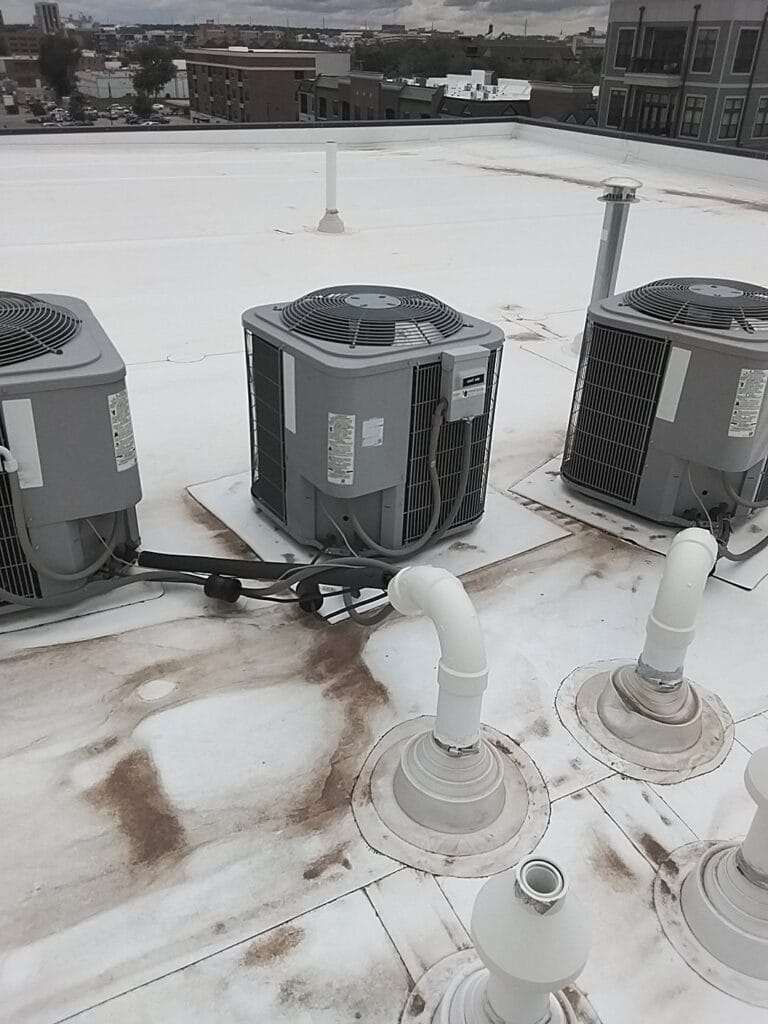
Two rooftop units. Both built in 2012. One has ten good years left. One dies next August.
That’s not unusual. That’s normal. And it’s why age-based planning fails managers who trust it.
Chronological age tells you how long a unit has existed. It says nothing about how hard that unit has worked. A packaged unit fighting a choked duct system, running long cycles for a tenant who never shuts the lights off, is aging at something closer to double speed.
So stop asking how old the unit is. Start asking how old it acts.
That single reframe is what makes a remaining-life estimate credible — and it’s the part almost every capital request leaves out.
Turning a Date Code Into an Effective Age
Here’s the scoring method. Start with the manufacturer’s date code stamped on the data plate, not the install date in your file. Files are wrong more often than anyone admits.
Then add years for each stress signal the unit is showing.
| Stress signal | What it’s telling you | Years to add |
| Static pressure above 0.8″ w.c. | The blower fights the ductwork every minute it runs | +3 |
| Temperature split under 15 degrees | Unit isn’t moving heat like it should | +2 |
| Compressor amps within 10% of rated load | Working at its limit, not inside it | +2 |
| Two or more component failures in three years | That’s a pattern, not bad luck | +3 |
| Failed or disabled economizer | Mechanical cooling running when free cooling would do | +1 |
| Extended runtime tenant (server room, 24/7 use) | Roughly double the operating hours | +2 |
| Rusted curb, standing water, damaged cabinet | The box fails before the guts do | +1 |
A 2012 unit with high static pressure, a weak split, and two board failures isn’t 14 years old. It’s acting like a 22-year-old unit, and it will behave like one.
Meanwhile, that clean 2012 unit next to it — normal static, healthy split, no repair history — is genuinely 14. Same year. Completely different plan.
From Effective Age to a Replacement Year
Now the conversion. Commercial rooftop equipment in Iowa typically runs 15 to 20 years under consistent maintenance, so effective age maps cleanly onto a planning window.
| Effective age | Estimated remaining life | Where it belongs in your plan |
| Under 10 years | 8+ years | Monitor annually, operating budget only |
| 10–13 years | 5–7 years | Years 4–5 of the sequence |
| 14–16 years | 3–4 years | Years 2–3, fix airflow issues now |
| 17–19 years | 1–2 years | Next capital cycle, shoulder season |
| 20+ years | Under a year | Current cycle, or accept an emergency |
Is this precise? No. It’s an estimate, and you should call it one out loud.
But here’s what matters. An estimate built on measured readings and stated assumptions beats a confident guess every time, because ownership can see how you got there. Show the method and the argument stops being about your credibility.
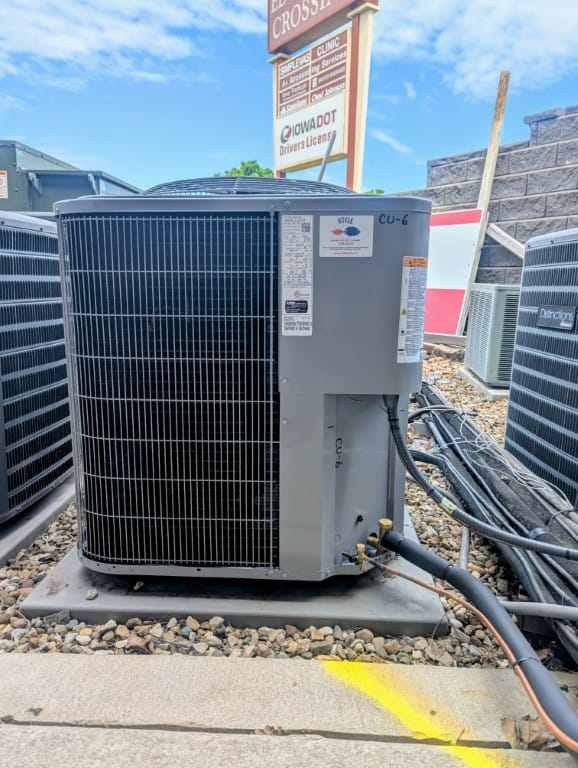 Novak Heating and Cooling has worked on this region’s mechanical systems since 1934, and the pattern holds: rooftop units telegraph their decline for years. The readings exist. They just rarely make it onto paper where a manager can use them.
Sequencing: The Part Everyone Gets Backward
You have your list. Every unit has an effective age and a rough replacement year. Now you have to decide the order — and this is where good plans fall apart.
Most managers sort by age and stop. Oldest first, straight down the list. Simple, and usually wrong.
Real sequencing weighs four things that have nothing to do with age.
Tenant consequence. A 17-year-old unit over a storage mezzanine is less urgent than a 13-year-old unit over your anchor tenant. Rank by what a July failure would actually cost in dollars and goodwill.
Roof schedule. This one saves real money and almost nobody catches it. Never set a new unit on a membrane you’re replacing in two years. Pull the equipment forward to land after the roof work, or push it back. Coordinating those two calendars can save five figures in crane and flashing costs.
Lease timing. Replacing a system under a suite going dark in eight months is capital spent on an empty room. Check the rent roll before you check the roof.
Crane logistics. If three units share a roof and a single crane setup, doing them together in one mobilization costs meaningfully less than three separate visits. Sometimes pulling a year-3 unit forward into year 2 is the cheaper move.
Sound familiar? Most of these tradeoffs never surface because nobody sees the whole portfolio on one page at the same time.
The Smoothing Trap
Finance people love an even spend. Two units a year, every year, predictable as rent.
Here’s where that logic breaks. Even spending ignores mobilization cost, and it ignores the fact that failure risk isn’t evenly distributed across your portfolio.
If four units are all sitting at effective age 18, spreading them across four years means gambling on three of them making it. Two won’t. Now you’re paying emergency rates, on the vendor’s timeline, during the exact week you have the least leverage.
Cluster where the risk clusters. Smooth where you genuinely can. And when you present it, show ownership the emergency premium you’re avoiding — planned shoulder-season work versus a July crane call is a meaningful difference on identical scope.
That’s the number that moves a budget meeting.
Two Factors Reshaping Every Timeline Right Now
Refrigerant belongs in your plan, and it changes the math.
R-410A production ended in January 2025. New equipment ships with R-454B or R-32. Service refrigerant for existing systems is on a phase-down, so repair costs on anything installed roughly between 2010 and 2024 are climbing — and will keep climbing.
What does that do to a five-year sequence? It shortens the useful life of “nurse it along” as a strategy. A unit you planned to limp through year four may not be worth the repairs it takes to get there.
The exception is worth naming. A clean unit with low run hours and no airflow problems is still worth repairing. Don’t replace healthy equipment because of a headline.
Lead time is the second factor. Commercial equipment has run two to eight weeks depending on tonnage and configuration, and specialty builds run longer. A sequence without ordering lead time built in isn’t a plan — it’s a wish.
The Scope Question That Wrecks Multi-Year Budgets
Here’s the failure mode that quietly destroys good capital plans.
You budget $40,000 for a rooftop swap. Mid-project, the contractor discovers the return duct is undersized and the electrical service won’t carry the new unit. Change orders land. Year two’s budget gets eaten by year one’s surprises, and the whole sequence collapses.
The cause is almost always the same: the quote priced the box and ignored the air path.
This is where Novak Heating and Cooling works differently from most contractors in the corridor. The company is a sheet metal contractor first. Owner Randy Novak won SMACNA’s national Contractor of the Year award in 2021 and served as the sheet metal association’s national president. SMACNA is the trade body for ductwork — the delivery system, not the equipment — and there’s an in-house fabrication shop right here in Hiawatha.
Why should a facility manager care? When a unit can’t hold a suite at setpoint, the answer is not automatically a bigger unit. Very often it’s a distribution problem that a bigger unit won’t fix, and you’ll have spent capital to buy back the same tenant complaint.
Cooling is a delivery problem. Get the duct scope inside the quote instead of discovering it on install day, and your multi-year numbers hold. A focused duct and airflow assessment on flagged units is cheap insurance against a plan that unravels in year one.
Frequently Asked Questions
How accurate can a remaining-life estimate be without a full engineering assessment?
Accurate enough to plan against, which is the actual bar. Four measured readings — static pressure, temperature split, amp draw against rated load, and the date code — plus repair history typically place a unit inside a two-to-three year window. That’s enough resolution for a capital sequence, since you’re deciding fiscal years, not months. Full load calculations and duct studies belong only on the units you’re funding this cycle.
How far out should a commercial replacement plan run?
Five years is the practical horizon. Beyond that, refrigerant rules, efficiency standards, and equipment availability shift enough that the back end becomes fiction. Build years one and two with quoted scopes, years three through five with estimated ranges, then re-baseline annually. Re-reading a portfolio takes a fraction of the original effort because your test points are already established.
Should I bundle replacements to save money, or spread them for cash flow?
Bundle when units share a roof and a crane setup, and when several units carry similar failure risk. A single mobilization covering three units costs meaningfully less than three separate mobilizations. Spread when the units are on separate buildings, when risk is genuinely staggered, or when ownership’s cash constraints are real. The mistake is spreading four high-risk units evenly and losing two to emergency failure before their scheduled year.
What should I require from a contractor to keep multi-year budgets accurate?
Insist that quotes price the whole scope: curb adapter, electrical capacity, duct modifications, and controls, not just the unit. Ask for measured static pressure before the quote, not after the install. Then put recurring measured readings into a maintenance agreement so your effective-age scoring refreshes automatically each year instead of depending on which technician shows up.
Stop Estimating Ages. Start Estimating Years.
You will never get funded for a comprehensive audit of every unit you manage. Accept that and move on, because you don’t need one.
Date code, four readings, stress adjustments, effective age, replacement year. Then sequence by tenant consequence, roof schedule, lease timing, and crane logistics — not by age alone. That’s a defensible multi-year air conditioner replacement plan, and it costs a week of scattered effort instead of a consulting fee you were never getting approved.
One thing is worth insisting on: whoever prices your replacements should measure the air path, not just the box. A quote that ignores the ductwork is a change order waiting to happen, and change orders turn five-year plans into one-year plans.
Novak Heating and Cooling has fabricated and installed this region’s ductwork since 1934, and the shop is still in Hiawatha. If you want measured condition data and full-scope numbers before your next budget cycle closes, start with commercial HVAC service and ask for readings on your copy of the report — or bring a flagged unit straight to a commercial installation conversation.
Pick your three worst units this week. By the time ownership asks how many years you have left, you’ll have an answer with a method behind it.