Your Roof Is Full of Question Marks. Here’s How to Fix That Fast.
 You have 14 rooftop units spread across six buildings. You know two of them are old. You couldn’t tell anyone which two.
Sound familiar?
Look, this is the position most property and facility managers in Linn County are in right now. Not because you’re careless. Because nobody handed you a budget for a comprehensive condition audit, and you already have a full week without crawling around on a hot membrane roof with a clipboard.
So you wait. A unit dies on a Friday in July, a tenant calls, and suddenly you’re approving emergency Novak Heating and Cooling work at whatever the number is — because the alternative is a call from ownership asking why suite 200 is 88 degrees.
Here’s what this article will give you. A stripped-down field check that takes about 20 minutes per unit, produces real condition data, and lets you sequence air conditioner replacement across a whole portfolio without ever running a full compliance audit. You’ll also get a scoring method you can defend in a capital request, plus the numbers that actually predict failure.
Let’s get into it.
The Real Problem Isn’t the Units. It’s the Blank Spreadsheet.
Aging rooftop equipment isn’t unusual. Every portfolio has it. What makes it dangerous is having no condition data to plan against.
Without data, every unit looks the same on paper. A 9-year-old unit that’s been abused sits in the same column as a 17-year-old unit that’s been maintained beautifully. You can’t rank them. And if you can’t rank them, you can’t build a replacement sequence — so you default to running everything until it breaks.
That’s the most expensive strategy there is. Emergency air conditioner replacement costs more, happens on the vendor’s timeline instead of yours, and burns tenant goodwill you spent years building.
But here’s the thing. You don’t need a comprehensive audit to get out of this. You need four numbers per unit.
The Four Numbers That Tell You Almost Everything
After more than 90 years working on this region’s mechanical systems, Novak Heating and Cooling has learned that most rooftop failures announce themselves long before they happen. The signals just don’t get written down.
Number one: the date code. Not the install date in your file — the manufacturer’s date code stamped on the unit’s data plate. Files lie. Data plates don’t. This tells you real age.
Number two: total external static pressure. This is the one almost nobody measures, and it’s the one that predicts failure best. Static pressure is the resistance the blower fights to push air through the ducts. Design is usually around 0.5 inches of water column. Plenty of real rooftop units are running 0.9 or higher.
Why does that matter? A blower fighting high static pressure runs hot, pulls extra amps, and kills the compressor early. High static pressure is why a “12-year unit” dies at year nine.
Number three: temperature split. Measure the air going into the unit and the air coming out. A healthy system delivers roughly a 16 to 22 degree drop. A weak split means low charge, a fouled coil, or airflow problems. It takes two minutes.
Number four: compressor amp draw versus the rated load amps on the plate. If a compressor is pulling near or above its rated number, it’s working itself to death. That’s a unit on borrowed time no matter what year it says on the plate.
Four numbers. Twenty minutes. No engineering firm required.
Why Static Pressure Is the Number Nobody Gives You
Most service reports you get back say things like “unit operational” or “cleaned coil, checked charge.” That’s activity, not condition.
Static pressure is different because it measures the distribution system — the ductwork, the filters, the diffusers — not just the box. And the distribution system is where commercial cooling problems actually live.
This is where Novak Heating and Cooling sits differently than most contractors in the corridor. The company is a sheet metal contractor first. Owner Randy Novak won SMACNA’s national Contractor of the Year award in 2021 and served as the sheet metal association’s national president. SMACNA is the trade body for ductwork — the air path, not the equipment. There’s an in-house fabrication shop in Hiawatha.
That matters to you for one reason. When a rooftop unit can’t keep a suite cool, the answer is not automatically a bigger unit. Very often the answer is a duct problem that a bigger unit will not fix, and you will have spent capital to buy the same complaint back.
Measured airflow first. Quote second. That order saves portfolios real money.
Triage Tiers: Match the Effort to the Stakes
You don’t have time to do everything at the same depth. So don’t.
Here’s how to split a portfolio into three levels of scrutiny, based on how much a failure would actually cost you.
| Tier | Which units | What you measure | Time per unit | What you get |
| Tier 1: Fast triage | Every unit in the portfolio | Date code, temp split, static pressure, amp draw | ~20 minutes | A ranked list and a rough failure window |
| Tier 2: Focused workup | Units that scored poorly, or serve a critical tenant | Tier 1 plus coil condition, refrigerant type, economizer function, curb and roof condition | 1–2 hours | Repair-versus-replace call with a defensible number |
| Tier 3: Full assessment | Units you’re replacing in the next 12 months | Tier 2 plus load calculation, duct layout, static pressure by branch, electrical capacity | Half day | A scope that won’t grow mid-project |
The insight here is that Tier 3 work is where audits usually start — and that’s backwards. Full assessments are expensive and slow. Do them on the four units that matter, not on all fourteen.
Tier 1 tells you which four.
Turning Field Numbers Into a Budget Ownership Will Approve
Now the part that saves your neck in the capital meeting.
Score each unit from the field check. Give it points for age, for static pressure over 0.8, for a temperature split under 15 degrees, for amp draw within 10% of rated, and for R-410A refrigerant. Then sort.
| Condition score | What it means | Action | Budget placement |
| 0–2 points | Healthy, normal wear | Maintain and re-check annually | Operating budget only |
| 3–4 points | Declining, watch closely | Targeted repair, fix airflow issues | Next fiscal year capital |
| 5–6 points | High failure risk | Plan air conditioner replacement | Current year capital, shoulder season |
| 7+ points | Failure is imminent | Replace now, before cooling season | Emergency reserve or accelerate |
The point isn’t the exact math. The point is that you walk into a budget conversation with a ranked list and measured evidence instead of a feeling.
Ownership rarely argues with numbers. They argue with vagueness.
The Refrigerant Change Nobody Told You About
One more factor belongs in your scoring, and it’s changing budgets right now.
R-410A production ended in January 2025. New equipment ships with R-454B or R-32 instead. Service refrigerant for existing systems is on a phase-down, and that’s pushing up the cost of repairing anything installed roughly between 2010 and 2024.
What does that mean for you? A major repair on an older R-410A rooftop unit now carries a cost curve that keeps climbing. The repair-versus-replace math has shifted, and units you would have nursed along for three more years may no longer be worth it.
The exception is a unit with an otherwise clean bill of health and low run hours. Those are still worth repairing. But the default assumption of “fix it, it’s cheaper” doesn’t hold like it used to.
What This Looks Like When It’s Done Right
Picture the version of this where you’re ahead of it instead of behind it.
You have a spreadsheet with four measured numbers per unit, updated once a year. You know which three units are replacing next year and roughly what they’ll cost. When a tenant complains about a hot conference room, you already know whether it’s the unit or the ductwork.
And when ownership asks why you need $80,000 in capital, you hand them a sorted list with static pressure readings on it.
That’s not a fantasy. It’s about a day and a half of field work across a mid-sized portfolio, and it replaces a comprehensive audit you were never going to get funded anyway.
If you’d rather not do the climbing yourself, that’s what commercial HVAC service is for. Ask for measured numbers in the report, not adjectives.
Frequently Asked Questions
How long does commercial air conditioner replacement take on an occupied building?
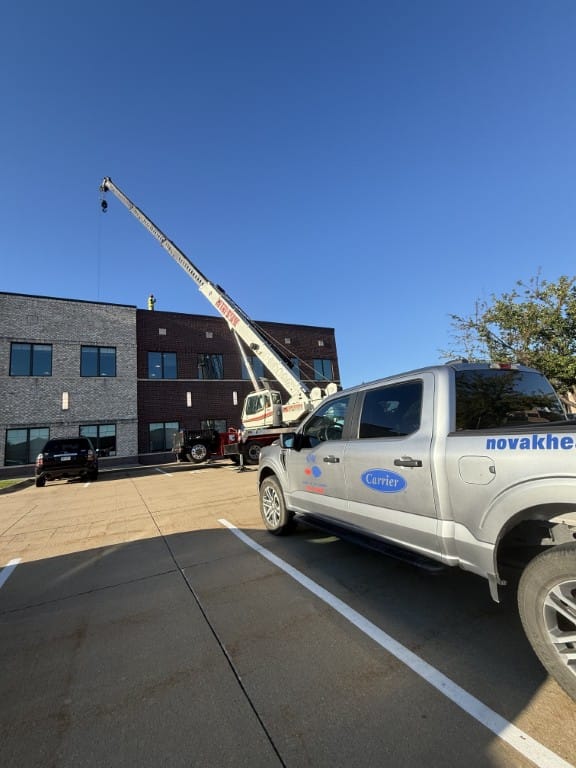
Most single rooftop unit swaps take one day, with a crane lift scheduled early morning. The real timeline driver is lead time on equipment, which has run anywhere from two to eight weeks depending on tonnage and configuration. Curb adapters, electrical upgrades, and duct modifications can add a day. This is why shoulder-season planning beats emergency work — you control the date instead of taking whatever’s open.
Can I replace a rooftop unit without touching the ductwork?
Sometimes, but check first. If measured static pressure is above about 0.8 inches, dropping in a new unit means the new blower will fight the same resistance the old one did, and you’ll shorten its life the same way. Measure before you buy. A duct assessment or airflow check on the front end is cheap insurance against replacing the same unit twice.
What’s the realistic service life of a commercial rooftop unit in Iowa?
Fifteen to 20 years with consistent maintenance, but that range collapses fast under real conditions. Units with high static pressure, dirty coils, or failed economizers commonly fail between nine and 13 years. Iowa’s swing from humid summers to hard winters is tough on cabinets, curbs, and coils, so roof and curb condition belongs in your assessment too.
How do I document maintenance history well enough to defend a capital request?
Ask your contractor for measured readings on every visit — static pressure, temperature split, amp draw, refrigerant pressures — not just a completed checklist. Three years of trended numbers show decline in a way that “serviced unit” never will. A structured maintenance agreement makes this consistent instead of dependent on which tech shows up.
Stop Guessing. Start Measuring.
You will never get funding for a comprehensive audit of every unit you manage. Fine. You don’t need one.
Four numbers per unit, twenty minutes each, scored and sorted. That’s enough to turn a portfolio of question marks into a replacement sequence you can defend, budget, and control. The units that need attention will separate themselves from the ones that don’t — and they’ll do it before July does it for you.
The one thing worth insisting on: whoever measures your equipment should measure the air path, not just the box. Cooling is a delivery problem, and a quote that ignores the ductwork is a quote for the same complaint next summer.
Novak Heating and Cooling has been fabricating and installing this region’s ductwork since 1934, and the shop is still here in Hiawatha. If you want measured condition data on your rooftop units before the next budget cycle, schedule a commercial assessment and start the list.
Your future self, standing on a roof in July with nothing on fire, will thank you.