

You Can’t Audit Everything. So Audit the One Thing That Bites.
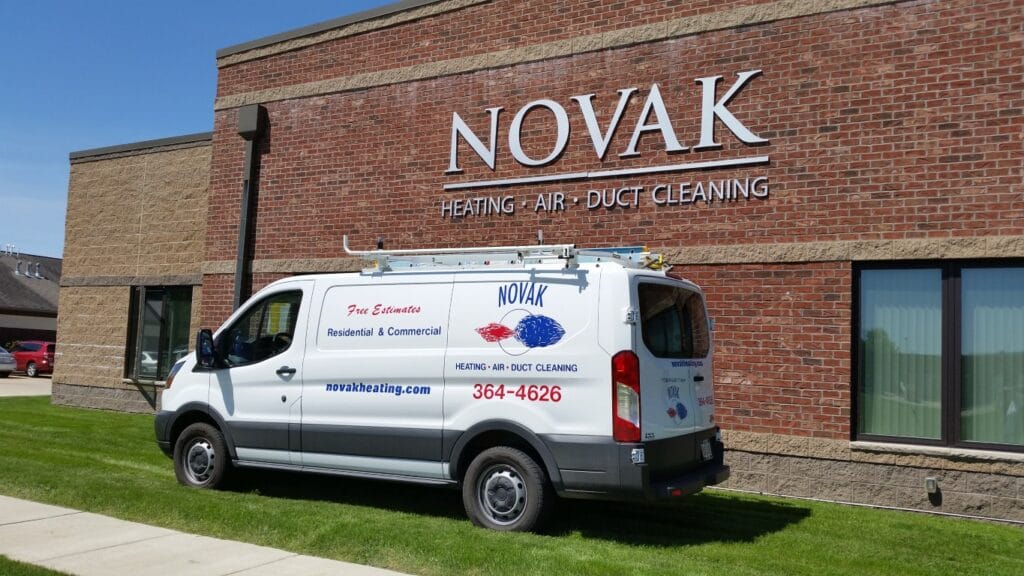 It’s 4:40 on a Friday in July. A rooftop unit quits over an occupied suite. You call your HVAC vendor, and the recording says “24-hour emergency service.”
Then nobody shows up until Monday.
Sound familiar? Look, this is the moment that exposes every gap in a property or facility manager’s program at once. Not the budget meeting. Not the walkthrough. The failure.
Here’s the thing, though. You’re never going to get funded for a comprehensive compliance audit of every unit you manage. You know it. Ownership knows it. But there’s a much smaller audit sitting right in front of you, it takes about half an hour, and it protects you far more than a clipboard on a hot roof ever will.
Audit your vendor’s response terms.
This article shows you exactly what to ask, what a real commitment sounds like versus a marketing claim, and how those terms quietly decide what your next air conditioner replacement costs you.
Why “24/7 Emergency Service” Is Not a Promise
Almost every contractor in Linn County says it. Banners, trucks, voicemail greetings. And here’s the uncomfortable part — most of those same companies post business hours of roughly 8:00 to 4:30, Monday through Friday.
So what does the claim actually mean? Usually it means somebody answers a phone. That’s availability. It is not response.
The difference matters enormously to you, because you don’t get judged on whether a phone rang. You get judged on how long suite 200 sat at 88 degrees.
An availability claim answers the question “can I reach you?” A response window answers “when will a technician be physically standing at my equipment?” Those are two completely different commitments, and only one of them ends the tenant email chain.
Frustrating, isn’t it? You’ve probably been burned by this exact gap and had no language to fight it with. Let’s fix that.
The Six Questions That Make Up Your 30-Minute Audit
Pull your current service agreement. Get whoever owns the account on the phone. Ask these six things, and write down the answers word for word.
First, what is the guaranteed on-site arrival window for a no-cooling call in an occupied commercial space? You want a number in hours, not a promise to “prioritize.”
Second, does that window change after hours, on weekends, or during a July heat wave when everyone is calling at once? A four-hour weekday window that becomes “next business day” on Saturday is really a weekday-only agreement.
Third, who answers at 9 p.m. — a dispatcher with access to the schedule, or an answering service that takes a message? Ask what happens to that message between 9 p.m. and 7 a.m.
Fourth, what are the after-hours rates, and are they published? Surprise invoices are their own kind of emergency.
Fifth, can a tenant call directly, and will you be notified when they do? Tenant dispatch either exists as a workflow or it doesn’t.
Sixth, if the unit can’t be repaired that night, what’s the temporary cooling plan, and who pays for it?
Six questions. One phone call. That’s the whole audit.
Claim Versus Commitment: What to Listen For
Vendors rarely lie outright. They speak in soft language, and soft language is the tell.
| What you hear | What it usually means | What to ask instead |
| “24-hour emergency service” | Someone answers the phone around the clock | “What’s the guaranteed on-site arrival window?” |
| “We’ll get someone out as soon as we can” | You’re in an unranked queue | “Where do commercial accounts sit versus residential calls?” |
| “Priority service for our customers” | Undefined and unenforceable | “Priority over what, and by how many hours?” |
| “We’re always available” | Availability, not arrival | “Is that window the same on a Saturday in July?” |
| “On-site within X hours, business hours; within Y hours after hours” | An actual commitment you can hold them to | Get it in the agreement in writing |
Notice the pattern. Every weak answer describes intent. Every strong answer contains a number.
Take the answers you collect and put them in your file next to the agreement. When ownership asks why you want to change vendors, that page is your argument.
How Response Terms Quietly Set Your Replacement Budget
Now here’s the part nobody connects, and it’s where real money lives.
A vague response window doesn’t just cost you a bad Friday. It pushes your air conditioner replacement decisions into emergency mode, and emergency mode is the most expensive way to buy equipment there is.
Think about how it plays out. A unit fails, nobody can tell you when a tech will arrive, the tenant escalates to ownership, and by hour 30 you’re approving whatever equipment is physically available at whatever the number is. No competing quotes. No load calculation. No duct scope. Just get it cooling.
| Planned replacement | Emergency replacement | |
| Who picks the timing | You do — shoulder season | The failure does — peak July |
| Equipment selection | Right-sized, quoted, compared | Whatever’s in stock |
| Ductwork included in scope | Yes, measured up front | Almost never |
| Crane and labor rates | Standard, scheduled | Premium, expedited |
| Tenant impact | Announced, brief | Days of complaints |
| Change orders mid-job | Rare | Common and unbudgeted |
The gap between those two columns is usually thousands of dollars per unit, plus goodwill you can’t put a number on.
So a defined arrival window isn’t just a service perk. It’s the thing that keeps a failure from turning into a rushed capital purchase you’ll regret for 15 years.
The Part Most Contractors Skip on an Emergency Call
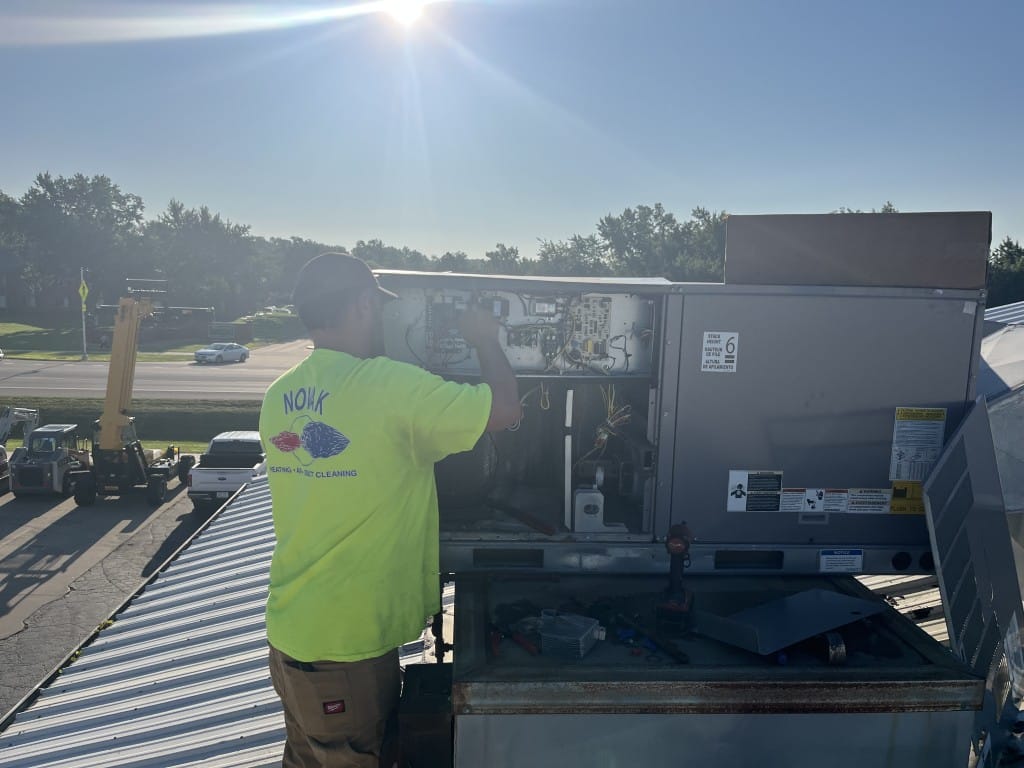 Here’s something worth knowing before your next 4:40 p.m. Friday.
When a rooftop unit can’t hold a suite at setpoint, the fastest answer is almost always “the unit’s shot, you need a bigger one.” Sometimes that’s true. Very often it isn’t.
A lot of commercial cooling failures trace back to the air path — undersized returns, crushed or leaking duct runs, filters and diffusers choking the system — not the box on the roof. High static pressure makes a blower run hot and pulls a compressor toward an early death. Replace the unit without fixing the path, and the new blower fights the exact same resistance. You buy the same complaint twice.
This is where Novak Heating and Cooling works differently than most contractors in the corridor. The company is a sheet metal contractor first, with an in-house fabrication shop in Hiawatha and 92 years of installing this region’s ductwork. Owner Randy Novak won SMACNA’s national Contractor of the Year award in 2021 and served as the sheet metal association’s national president. SMACNA is the trade body for ductwork — the air path, not the equipment.
Why should that matter to you at 9 p.m. with a hot suite? Because the tech who can measure static pressure on the emergency call is the one who can tell you, that night, whether you’re looking at a repair, a replacement, or a duct problem. That’s the difference between a decision and a guess.
Cooling is a delivery problem. Emergency response should diagnose delivery, not just swap parts. You can see how that plays out in commercial HVAC repair and in emergency AC service.
One More Thing Changing Your Emergency Math
Put this in the file, because it’s moving numbers right now.
R-410A production ended in January 2025. New equipment ships with R-454B or R-32 instead, and service refrigerant for existing systems is on a phase-down that keeps pushing repair costs up on anything installed roughly between 2010 and 2024.
What that means practically: an emergency repair on an older R-410A rooftop unit is no longer a stable number. It’s a number climbing every year you defer.
The exception is a clean unit with low run hours and no airflow problems. Those are still worth repairing, and a contractor who tells you so is one worth keeping. But the old reflex of “just patch it, it’s cheaper” doesn’t hold the way it did three years ago.
Frequently Asked Questions
What’s a reasonable emergency arrival window for a commercial no-cooling call?
For an occupied commercial space during business hours, a two-to-four-hour on-site window is realistic in the Cedar Rapids area. After hours and weekends usually stretch to same-night or next-morning, which is fine — as long as it’s stated as a number rather than a vibe. The wrong answer isn’t a longer window. It’s an undefined one, because you can’t plan a tenant communication around a window nobody will name.
Should the arrival window be written into the service agreement?
Yes, and it’s the single highest-value edit you can make to a contract you’ve already signed. Ask for the window, the after-hours variation, the after-hours labor rate, and the escalation contact to appear in writing. A vendor who commits to numbers has staffed for them. One who won’t put a number on paper is telling you something useful, and you should believe them.
Does an emergency call actually cost more than planned replacement work?
Substantially. Emergency work carries premium labor, expedited equipment, and rushed crane scheduling, and it removes your ability to compare quotes or include duct scope. Planned commercial installation scheduled in the shoulder season prices the full job up front — curb adapter, electrical capacity, duct modifications — instead of surfacing them as change orders while a tenant waits.
How do I reduce emergency calls without a full compliance audit?
Cover the highest-consequence units first. A maintenance agreement on the equipment serving your most sensitive tenants catches failing capacitors, dirty coils, and airflow restrictions before July does. Ask for measured readings — static pressure, temperature split, compressor amp draw — on your copy of every report. Those numbers double as the evidence behind your next capital request.
Make Them Say a Number
You will never audit every unit in your portfolio. Stop feeling bad about it.
But you can audit six answers in half an hour, and those six answers decide what happens on the worst afternoon of your year. Availability is a marketing claim. A defined arrival window is a commitment. Only one of them helps you when the phone rings.
Novak Heating and Cooling has been fabricating and installing this region’s ductwork since 1934, and the shop is still right here in Hiawatha. If you want your response terms and your replacement plan handled by the same people who can measure the air path, start with a commercial service conversation — and ask us for the number too.
Then go make your current vendor say theirs out loud. You’ll learn a lot in about 30 seconds.